Manual vs electric citrus juicer: which fits your kitchen
The decision that comes before the model: a cast iron lever press or an electric citrus press. Volume, effort, counter space, what breaks and what does not.
The question is not which model
Nearly every buyer in this category starts with a model number and works backwards. That is the wrong end. The first fork is whether a motor should do the pressing, and the answer follows from three things: how much juice you make at a time, how often, and whether you are willing to learn a technique.
Get that fork right and either machine will make you happy for years. Get it wrong and you will own a press that is either too slow for your morning or too fussy for your Saturday.
What a lever press actually asks of you
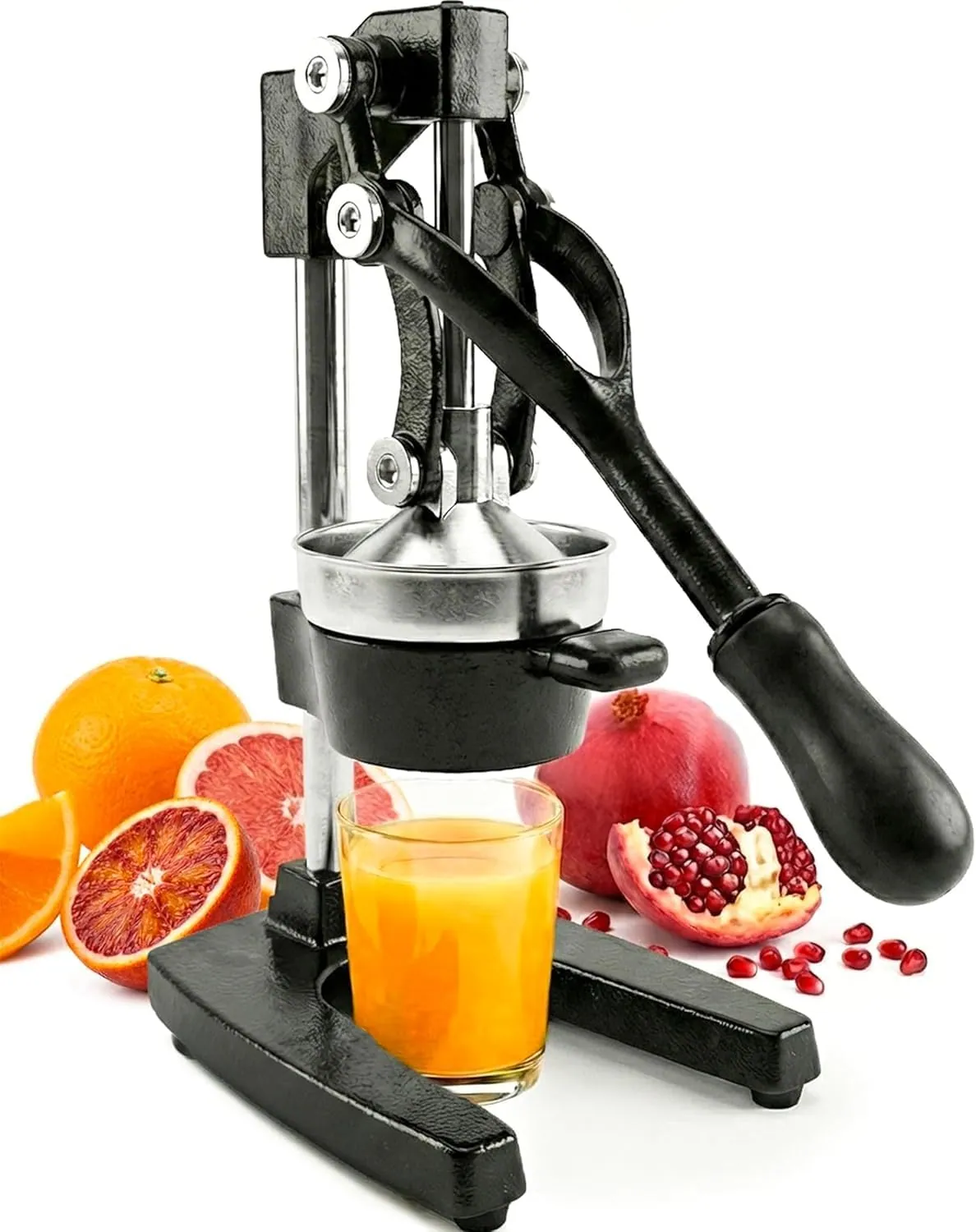
A cast iron lever press has no motor, no drive gear and no plastic part waiting to shear. It has a long arm, a cone, and your body weight. That is the whole machine, and it is why market stalls still use this shape.
What it asks in return is technique and space. Roll the fruit on the counter to break the segments before you cut. Cut level, so the half sits flat on the cone. Pull once, firmly, all the way down: two half-hearted pulls leave more juice in the shell than one committed one. And find it a home: ours is listed at 18.3 lb, which is exactly the mass that stops it walking while you pull.
What an electric press asks of you
An electric citrus press asks for almost nothing while it works: put the half on the cone, press down, and the pressure starts the motor. Lift and it stops. There is no switch to find with sticky hands and no wrist twisting.
What it asks is discipline. Press straight down, never rock the handle sideways, and let the motor set the pace instead of leaning harder when the pitch drops. Rest it after a big batch. Those three habits are the entire difference between an electric press that lasts seasons and one that fails in a month, and they are the reason this site has a whole care guide.
Volume: the number that decides
A glass or two a day is electric territory: the press is faster than fetching the lever press from the cupboard, and the parts go in the dishwasher while you drink.
A bag of limes for a party, a crate of oranges on a market morning, or pomegranates in season is lever territory. There is no duty cycle to respect, nothing gets hot, and the only limit is your arm. The people who juice both ways usually keep the electric on the counter and the lever press for the big days.
The honest table
| Cast iron lever press | Electric press | |
|---|---|---|
| Effort per fruit | One firm pull | A push, motor does the work |
| Volume without a break | As long as your arm lasts | A pitcher, then a short rest |
| Pomegranates | Yes | No |
| What can fail | Almost nothing mechanical | Plastic drive parts, if fought with |
| Storage | Heavy: 18.3 lb per the product page | Light enough to move weekly |
| Noise | The sound of a lever | A hum while pressing |
| Cleaning | Cup, cone, strainer | Cone, strainer, spout, cover |
If you are still torn
Buy for the batch you actually make, not the batch you imagine. Most households juice a glass at a time and reach for the machine that is already on the counter. That is an electric press, and the compact is enough of one if the counter is small. Households that entertain, run a stand, or juice pomegranates want the lever.
And if your shopping list has apples or kale on it, stop here: neither of these machines is for you, and the press-versus-centrifugal explainer says why.
Where to go next
- Compare all four side by side
- Citrus press vs centrifugal vs masticating
- Care that prevents the common failures
About the author
Casey Whitmore writes the guides on this site. Casey squeezes citrus most days of the week, on every juicer we make, and keeps notes on what works, what breaks and what is worth the counter space. No certificates, no titles: just a lot of juiced limes.